





House of Lords roundtable explores digital twins, energy and the future of UK transport
Article courtesy of Vicky Masterson, TransiT
The House of Lords was the prestigious venue this week for an industry roundtable event convened by TransiT and Connected Places Catapult.
British peers the Earl of Erroll and Baroness Uddin hosted the discussion, which explored the role of digital twins and energy networks in decarbonising UK transport across road, rail, maritime and aviation.
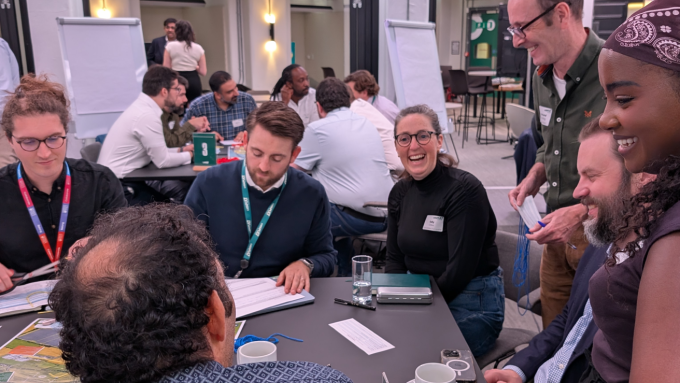
Fifteen invited industry guests from sectors including transport, energy, logistics, technology, security, academia and engineering took part in the event, which was entitled Connected Infrastructure for Net Zero: Digital Twins, Energy Systems and the Future of UK Transport.
Lord Erroll has a background in industries including information technology, the Internet of Things and artificial intelligence and an interest in digital policy and smart systems.
Baroness Uddin is an activist and entrepreneur with a strong interest in creating an inclusive digital ecosystem.

Professor David Flynn at Westminster.
TransiT joint programme lead Professor David Flynn, a specialist in cyber-physical systems at the University of Glasgow, chaired the roundtable. He said: “The UK’s pathway to net zero requires a fundamental transformation in how transport, energy and digital infrastructure are planned, operated and integrated. Decarbonising road, rail, maritime and aviation will involve converging with energy networks, underpinned by communications systems, data platforms and intelligent infrastructure. To deliver this transition efficiently, we need a more connected and coordinated approach across traditionally separate sectors. By bringing together senior leaders and experts from the transport, energy and digital technology sectors, alongside government and academia, we’re providing an important forum to explore these different perspectives.”
Connected Places Catapult is the UK’s innovation accelerator for cities, transport and place leadership. It recently published the Digital Twins: State of the Nation Report, commissioned by the Department for Transport (DfT), which examines how digital twin technology is being developed and deployed across UK transport.
Citing the report, Ali Nicholl, Data & Digital Strategic Engagement Director at Connected Places Catapult, described connected digital twins as a “generational opportunity” to drive UK growth. He added: “The UK has strong technical capabilities, operational examples and growing ambition on a regional and national level. But we consistently see not a technology gap, but a gap in deployment between sectors and across regions. The challenge is to address the barriers behind that gap, including fragmented governance, inconsistent data standards, lack of structural trust and limited interoperability.”
The industry guests taking part in the discussion included:
- Emma Bayliss-Chan, Head of Climate Strategy & Risk, Royal Mail
- Phil Blythe CBE, Professor of Intelligent Transport Systems at Newcastle University and Director of the DARe National Hub for Decarbonised, Adaptable and Resilient Transport Infrastructures
- Geraldine Buckland, Chief People Officer, Elexon
- Jon Elphick, Fellow and Digital Rail Advisory Director, WSP in the UK & Ireland, and Professor in Practice at Durham University
- Mark Enzer, Fellow, Mott MacDonald and chair of The Built Environment Connective
- Steve Hervouet, Chief Strategy and Regulation Officer, Smart DCC
- Zoya Pourmirza, Senior Lecturer | Associate Professor, Keele University
- Phil Roe, President, Logistics UK
- Jamie Sands, Head of Solutions, Welch Group
- Zubran Solaiman, Director of Infrastructure Policy Advancement for the UK, Ireland and Nordics, Bentley Systems
- David Wagg, Professor of Nonlinear Dynamics, The Alan Turing Institute
- Jesper Christensen, Operations Director, DFDS
- National Cyber Security Centre
- Lee Juby, Member of the Hydrogen Energy Association’s Executive Committee, Verray Consulting

TransiT and CPC team members from left to right: Charlotte Preston, Barbara Alvarez Solanilla, David Flynn, Adam Kesby, Rebecca Advani, Catherine Condie and Shipra Samanta.
The House of Lords roundtable was the culmination of a series of four workshop events hosted for TransiT by Connected Places Catapult.
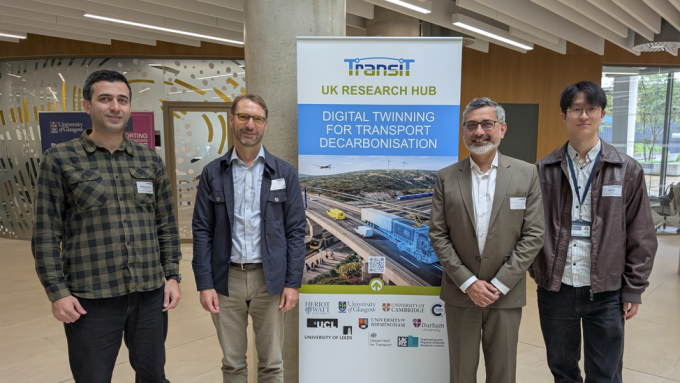
TransiT is a UK research hub using digital twins – digital replicas of the physical world – and associated technologies to identify low-risk, low-cost routes to zero emission transport in the UK.
It is a collaboration of eight universities and almost 70 industry partners, jointly led by Heriot-Watt University in Edinburgh and the University of Glasgow, and supported by the UKRI Engineering and Physical Sciences Research Council (EPSRC), the main funding body for engineering and physical sciences research in the UK, and by the UK government’s Department for Transport.
TransiT’s other university partners are University of Leeds, University of Birmingham, Cranfield University, University College London, University of Cambridge and Durham University.
Connected Places Catapult connects businesses and public sector leaders to cutting-edge research to help showcase, develop and scale new solutions that drive growth, spread prosperity and reduce carbon emissions.
The UK government is committed to developing national capability in digital twinning to accelerate economic growth, net-zero goals and infrastructure resilience.
TransiT will continue to build on the foundations of this discussion, recognising the important role stakeholders play in delivering the future impact of digital twinning and decarbonisation of transport.
Leave a comment