



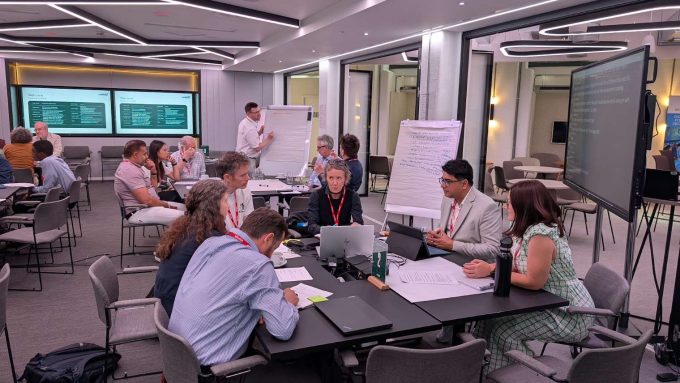

Connectivity is key to transport decarbonisation, industry event hears
Article courtesy of Vicky Masterson, TransiT
Reliable communication links that can continuously transmit data are critical to the UK’s ambitions to decarbonise transport, an industry event for UK research hub TransiT heard last week.
“Connectivity resilience isn’t a side detail,” explained Dr Mohammad Al-Quraan, a TransiT researcher and expert in Autonomous Systems & Connectivity at the University of Glasgow. “It’s foundational to the operation of driverless vehicles, digital twins and other ‘intelligent’ transport systems of the future that are key to decarbonising transport. If this connectivity fails, everything that depends on it inherits this fragility.”
The event, Connectivity for net zero transport: Building the UK’s cyber-physical architecture, took place at University of Glasgow’s Advanced Research Centre and was the third in a series of industry workshops to be hosted for TransiT by Connected Places Catapult, the UK’s innovation accelerator for cities, transport and place leadership.
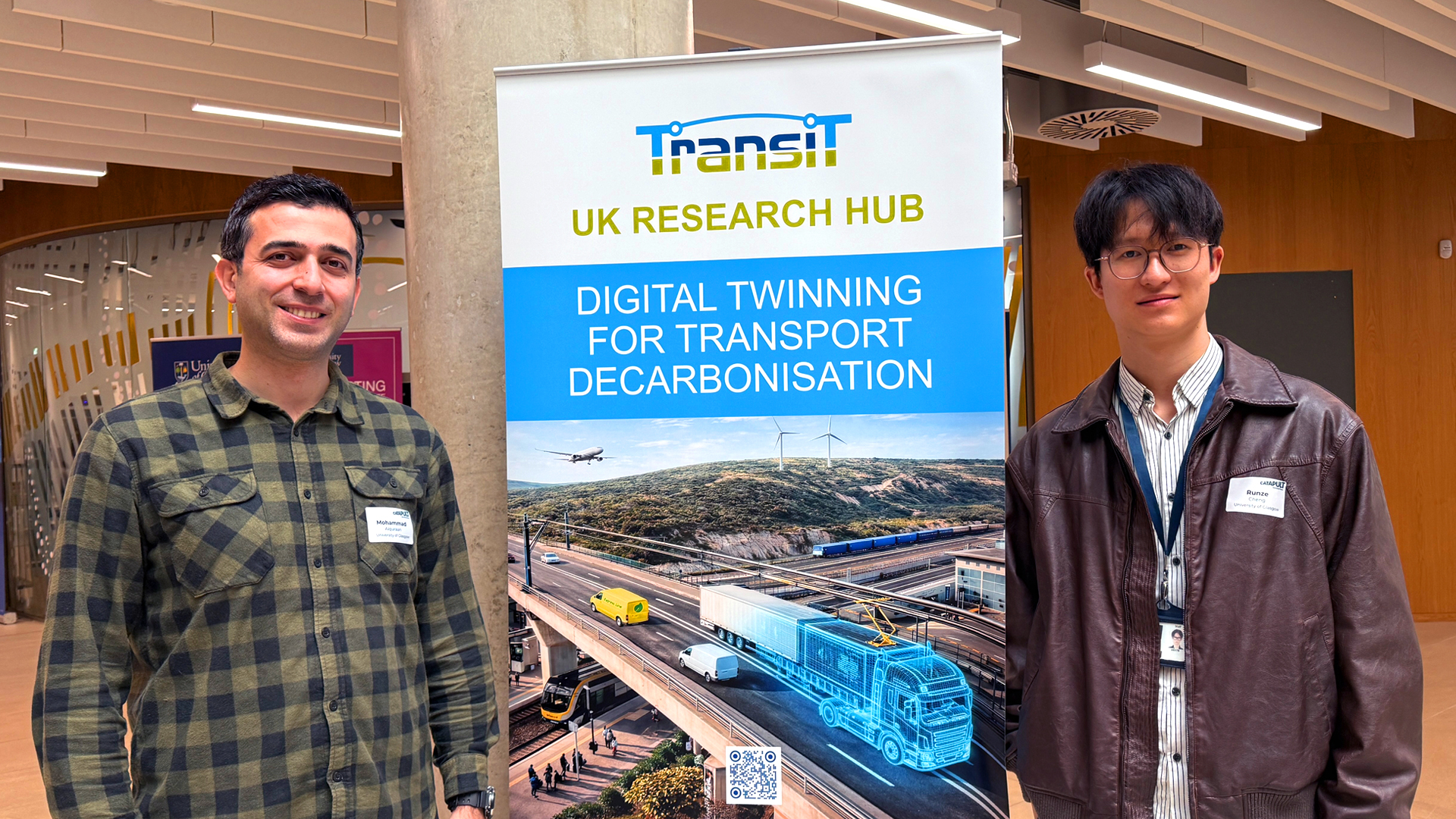
TransiT researchers Mohammad Al-Quraan (left) and Runze Cheng.
The event explored how telecoms, satellite, 5G and other communication networks transmit data between physical transport infrastructure, like vehicles and roads, to computer systems which monitor and operate this infrastructure. These ‘cyber-physical systems’ can help us better understand and predict what’s happening in the real world and underpin the viability of emerging technologies like digital twins.
Digital twins are constantly-updated virtual replicas of a real system, built from live sensor data, that are used to monitor conditions, flag problems early, and safely test ‘what-if’ scenarios before they happen in the real world.
TransiT is using digital twinning and associated technologies to identify the least-risky, lowest-cost routes to zero emission transport in the UK.
Opening the event, Professor Muhammad Imran, TransiT co-investigator and Head of the James Watt School of Engineering at University of Glasgow said: “Digital twinning will underpin how future transport is planned, operated and decarbonised, drawing on continuous information exchange between vehicles, infrastructure, operators and energy systems. Communications networks are the layer on which this depends – so they must be treated as a core component of the UK’s transport infrastructure.”
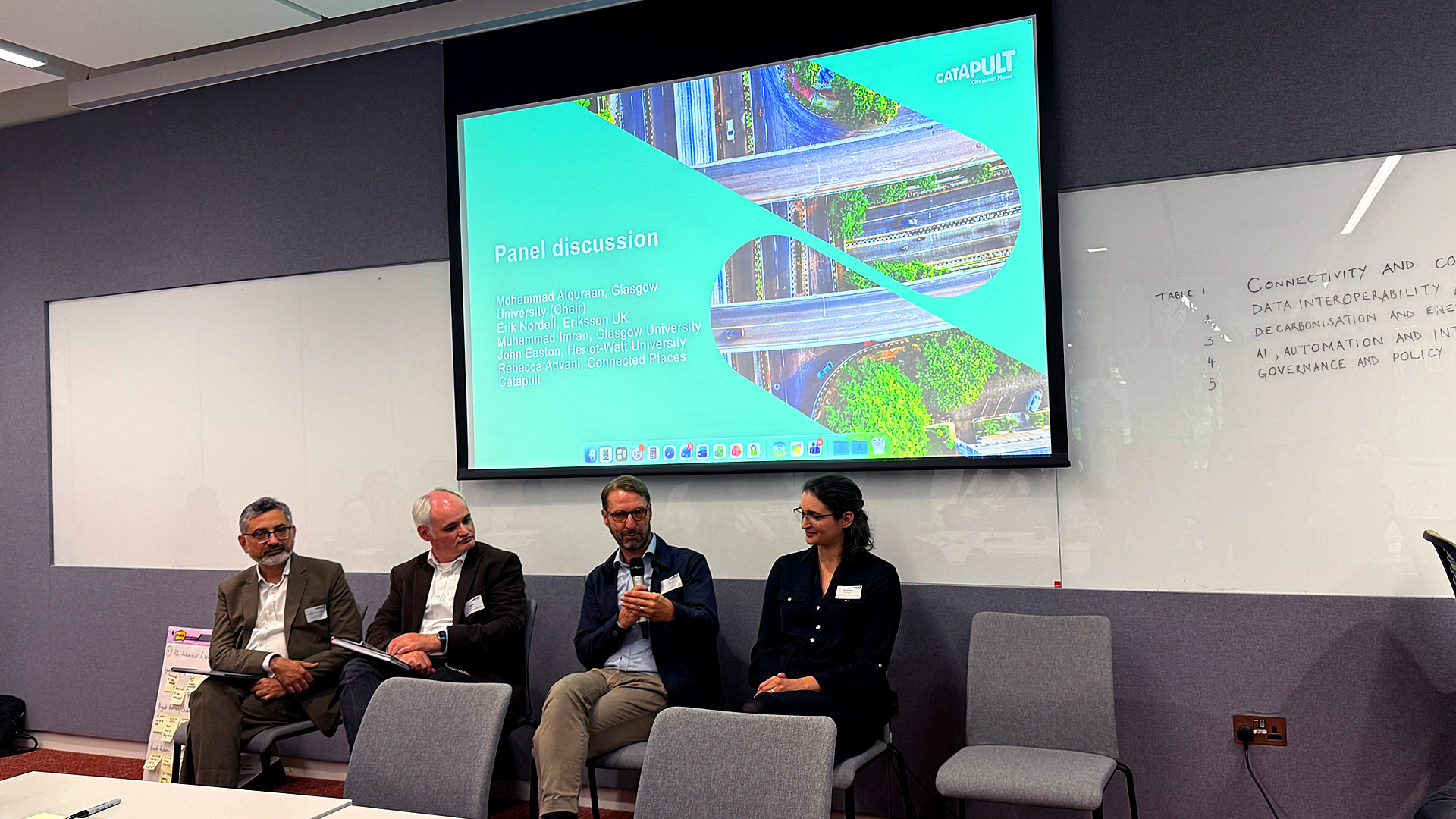
On the panel from left to right: Muhammad Imran and John Easton from TransiT, Erik Nordell from Ericsson and Rebecca Advani from Connected Places Catapult.
The event’s keynote presentation was delivered by Erik Nordell, Head of Research in the UK for Swedish networking and telecoms company Ericsson and an expert in satellite communications systems.
TransiT researcher Dr Runze Cheng delivered a presentation on how next generation wireless networks can transmit data more efficiently. He said: “With data volumes growing exponentially around the world, traditional communications networks are struggling to meet demand. My research is focused on an area called semantic communication, where we can reduce the bandwith needed to transmit data by only communicating the key meaning of the message – rather than large volumes of raw data – and only processing this data where computing resources are available.”
Around 40 industry guests took part in the event, which included two workshop sessions covering themes including connectivity and communications; data interoperability and digital twins; and decarbonisation and energy integration.
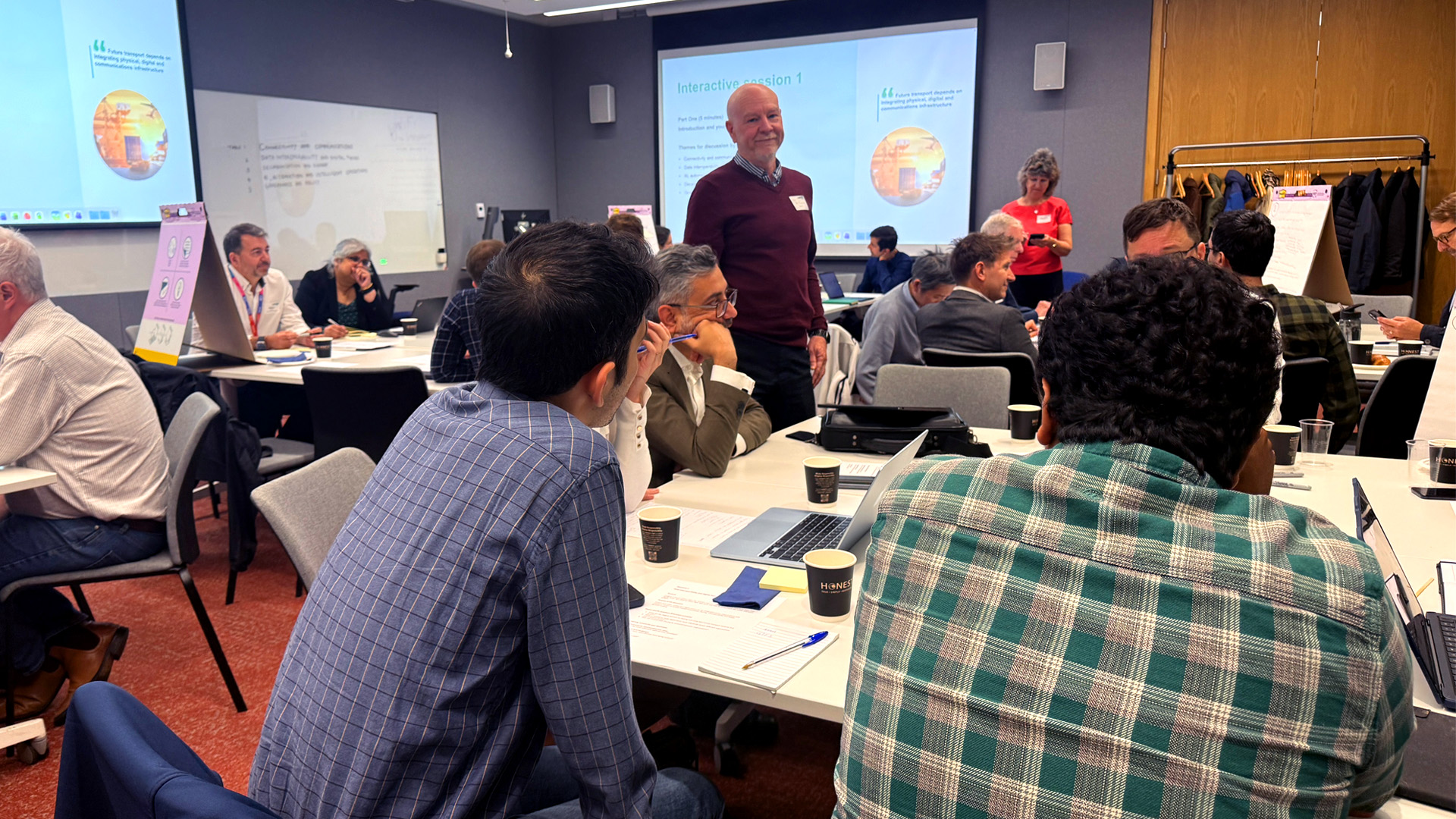
Workshop tables at the event.
TransiT co-investigator Dr Ahmad Taha leads the research hub’s work on connectivity and said: “Workshops like this are invaluable. They bring the right people around the table – academia, industry and infrastructure operators – and turn what could be a fragmented conversation into a shared roadmap for how connectivity underpins net-zero transport.”
TransiT is a collaboration of eight universities and almost 70 industry partners, jointly led by Heriot-Watt University in Edinburgh and the University of Glasgow, and supported by the UKRI Engineering and Physical Sciences Research Council (EPSRC), the main funding body for engineering and physical sciences research in the UK, and by the UK government’s Department for Transport.
Connected Places Catapult connects businesses and public sector leaders to cutting-edge research to help showcase, develop and scale new solutions that drive growth, spread prosperity and reduce carbon emissions.
The UK government is committed to developing national capability in digital twinning to accelerate economic growth, net-zero goals and infrastructure resilience.
Leave a comment