




Building connected digital twins for transport decarbonisation
Article courtesy of Vicky Masterson, TransiT
Transport digital twins that work together reliably, safely and at scale will play a vital role in decarbonising the UK’s transport system, an industry event for UK research hub TransiT heard last week.
The event, Designing for federation in digital twinning for transport, was the fourth in a series of industry workshops to be hosted for TransiT by Connected Places Catapult, the UK’s innovation accelerator for cities, transport and place leadership.
TransiT is using digital twins – digital replicas of the physical world – to identify low-risk, low-cost routes to zero emission transport in the UK. Its remit includes linking digital twins of different transport modes into ‘federations’, or networks, representing complex chains of the UK transport system, including road, rail, air and maritime, across both passenger and freight.

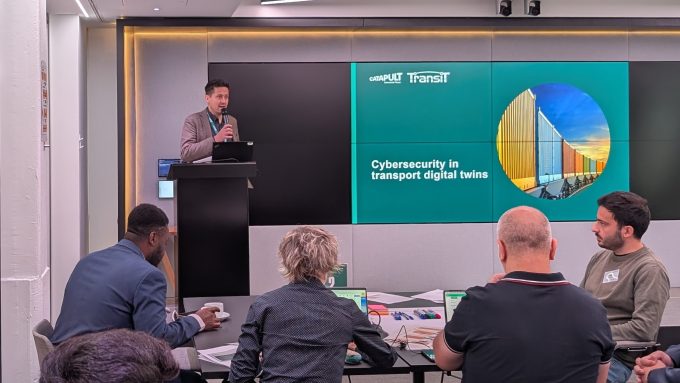
Ali Nicholl from Connected Places Catapult presenting at the event.
Opening the event, Ali Nicholl, Data & Digital Strategic Engagement Director at Connected Places Catapult, said: “Federation is a way for organisations to connect digital twins, models and data, but keep their own systems and information independent. These digital twin networks can help to address increasingly complex transport challenges that cut across modes, operators and geographical boundaries. And they can also deliver more than the sum of their parts, by providing analyses and insights that individual digital twins can’t.”
Dr Michele Sevegnani is a Reader in Computing Science at the University of Glasgow, where he leads TransiT’s research on the design and assurance of federated digital twins. He explained: “We need to federate digital twins of different transport modes without disrupting existing systems. For our decarbonisation predictions and decisions to be accurate, these twins must also be able to share data securely and reliably. This makes interoperability, supported by clear and enforceable data-sharing contracts, one of the central challenges in digital twinning for transport.”

Dr Michele Sevegnani (left) and Dr Theo Lim.
Around 50 industry guests took part in the event, which included a workshop game highlighting the complexities of connected digital twins.
Dr Theodore Lim, a TransiT co-investigator and systems engineering expert at Heriot-Watt University, led the game. He said: “We used maps, coloured wool and slips of paper representing interface contracts, to help guests understand how digital twins work together in a network. The key goal is not just to build the most connected system, but to build a resilient one. This means responding to changes and challenges in the system, as well as understanding how and where data flows between the different digital twins.”

The event panel left to right: Michele Sevegnani, Aditya Sivanand, Ali Nicholl, Katrina Thompson and Adam Sobey.
Professor Adam Sobey, Mission Director for Sustainability at The Alan Turing Institute, presented the event’s keynote address. The event also included a panel discussion with guests including Katrina Thompson, Director of the UK Digital Twin Centre, and Aditya Sivanand, Principal Data Scientist at the Department for Transport.
TransiT is a collaboration of eight universities and almost 70 industry partners, jointly led by Heriot-Watt University in Edinburgh and the University of Glasgow, and supported by the UKRI Engineering and Physical Sciences Research Council (EPSRC), the main funding body for engineering and physical sciences research in the UK, and by the UK government’s Department for Transport.
Connected Places Catapult connects businesses and public sector leaders to cutting-edge research to help showcase, develop and scale new solutions that drive growth, spread prosperity and reduce carbon emissions.
The UK government is committed to developing national capability in digital twinning to accelerate economic growth, net-zero goals and infrastructure resilience.
Leave a comment