




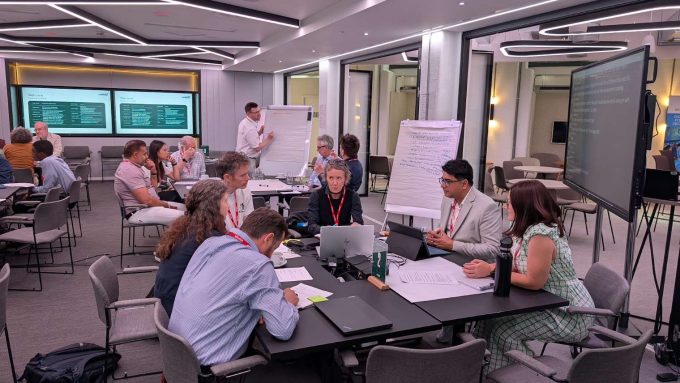
A National Conversation on Data, AI and Place
Drawing on five House of Lords roundtables (July 2025 – February 2026)
We would like to thank our roundtable host, Merlin Hay, The Earl of Erroll, for generously convening and hosting these discussions at the House of Lords. We also extend thanks to all participants for sharing their time, insight and expertise so openly, and for contributing to this series of constructive and forward‑looking discussions. Each of the five reports is available below.
Event series summary
Across five Connected Places Catapult roundtables convened at the House of Lords between July 2025 and February 2026, a consistent narrative emerged: the UK has world‑class assets in data, AI, geospatial insight and digital innovation, but value is still lost through fragmentation, duplicated effort and weak incentives to connect. Participants from government, regulators, industry, academia and infrastructure repeatedly emphasised that connection is now the binding constraint – not the absence of data, technology or ambition.
Collectively, this series of roundtables brought together 80 individuals representing around 50 organisations, and set out a clear proposition for government and industry: treat data sharing, interoperability and geospatial insight as national infrastructure, underpinned by trusted governance, clear incentives and skills embedded across organisations. The opportunity is not incremental improvement, but a step‑change – shifting from isolated pilots to cumulative national capability that delivers productivity, resilience and public value.
This extended article draws together the strongest insights from the five discussions and translates them into a set of cross‑cutting policy recommendations designed to catalyse action with government and industry. We propose that what comes next draws on the expertise we already have across these fields and provides a national blueprint that helps businesses to operate and grow safely.
“High quality curated data requires money and resources and is an investment in the fabric of the UK for the future.”
Grant Wilson, University of Birmingham
A shared diagnosis
1. From assets to outcomes
Across all sessions, participants agreed that the UK does not have a data scarcity problem. It has a value realisation problem. Data, AI and geospatial capabilities are strongest where they are anchored to clear outcomes – resilience, efficiency, risk reduction and growth – rather than abstract technical ambition. This perspective was particularly strong in discussions on geospatial insight, which participants repeatedly described as most powerful when it is treated as a decision‑making tool rather than a technical specialism.
“The UK will gain most by talking about geospatial in terms of outcomes like risk reduction, resilience and return on investment, rather than in terms of technologies or data types.”
Steve Smith, Satellite Applications Catapult
“Value and quality are a function of use case, rather than the data. Monetisation is an extreme way to do value exchange. There are simpler ways to start, such as sharing efficiency benefits from the use of a combined data source.”
Miranda Sharp, Metis Digital
The outcome‑led framing was echoed across AI readiness, data sharing and testbeds: innovation scales when it is anchored in real operational and policy questions, not proofs of concept.
2. Fragmentation is the enemy of scale
Each roundtable described a landscape rich in programmes but thin in connective tissue. Siloed governance, inconsistent standards, duplicated procurement and unclear liabilities repeatedly prevent learning and value from travelling between sectors and places. Participants consistently argued that connection itself must be treated as infrastructure, with shared frameworks that make collaboration repeatable, proportionate and safe.
“Scale should come from connectedness by thinking about interoperability from the start, which concurrently yields business pivot potential.”
Amit Bhave, CMCL
“There is a huge amount of work that’s been done on building trust and enabling interoperability for data sharing, but there remains a great deal to be done on generating and sharing value from data.”
Ben Ramsden, Crysalis Ecosystems
3. Trust, governance and licence to operate
Trust emerged as a foundational requirement. Whether discussing AI deployment, geospatial insight or cross‑sector data sharing, participants stressed that confidence depends on provenance, stewardship, explainability and clear accountability. There was strong consensus that security, privacy and ethics must be baked in, not bolted on, and that assurance of how systems are delivered matters as much as promised outcomes.
“Without clear rules on accountability, assurance and stewardship, even well‑intentioned data sharing will stall. Confidence in how data is governed is what allows collaboration to scale.”
National Data Governance roundtable participant
“We convene the industry, agree what data should be published and how, and run joint and independent risk assessments – that’s what builds confidence to share.”
Melissa Tallack, Northumbrian Water and Stream
“We must understand what information we are sharing and why, to ensure the need to know access and also its conditions around its sharing.”
Jonathan Eyre, AMRC
4. Incentives matter more than exhortation
Across sectors, data holders will share when benefits are tangible, fairly distributed and aligned with their operating reality. Moral arguments alone are insufficient. Regulated sectors highlighted the role of obligations and price controls. Elsewhere, procurement levers, reduced friction and shared upside models were seen as critical.
“Companies think about what’s in it for me. What is the incentive?”
Natasha Good, Freshfields
5. Place as a forcing function
Place‑based initiatives repeatedly emerged as the most effective way to force cross‑sector collaboration. Planning, infrastructure, resilience and net zero challenges naturally cut across organisational boundaries. Geospatial insight was identified as a uniquely powerful integrator, enabling disparate datasets to be related through location and translated into decision‑ready evidence.
“If you pick a place and a high‑value issue, you will engage multiple big data owners by necessity, not hope.”
National Data Governance roundtable participant
“To realise the full potential of geospatial insight, we should convene around realworld missions – such as climate resilience, health or infrastructure – and then align data and tools to those goals.”
Anna Angus‑Smyth, National Environmental Research Council (NERC)
6. Skills, culture and translation
Every discussion reinforced that data sharing and AI readiness are fundamentally socio‑technical challenges. Shortages are as acute in translation, leadership and data literacy as they are in advanced technical skills. Participants called for professionalisation, shared language and embedded capability rather than reliance on small expert teams.
“We need to professionalise data. We need to have codes of conduct, practices and a common language so that everyone understands what is meant when using these expressions and terms.”
Stuart Coleman, ODI
“If spatial thinking is taught only within geography, we limit its impact. To unlock national value, geospatial skills need to be woven into how we train data scientists, engineers and decision makers across the economy.”
Charles Kennelly, Esri
“Capability only sticks when it is embedded in day‑to‑day roles and incentives. We need to stop treating data and AI skills as a specialist add‑on and start making them part of how organisations operate.”
Skills and capability roundtable participant
Cross‑cutting policy recommendations
1. Establish a national orchestration function for data, AI and place
Create a lightweight, outcome‑focused cross‑sector orchestration function bringing together government departments, regulators, industry and academia. Its role should be to set guiding principles and a target national data architecture, align incentives, assurance and delivery across sectors and coordinate place‑based, public‑value use cases. This is not about central control, but about coherence and momentum.
2. Treat data sharing and interoperability as public digital infrastructure
Invest in shared assets that individual organisations cannot justify alone, including benchmarks, evaluation protocols and assurance frameworks, reference models, ontologies and exemplar licences, and federated catalogues and discovery services. These assets should be governed as national infrastructure, with multi‑stakeholder stewardship.
3. Reframe value in terms decision‑makers recognise
Mandate that publicly funded data and AI initiatives articulate value in terms of risk reduction and resilience, efficiency and time saved and regulatory confidence and system reliability. Technical excellence should be necessary but insufficient without a clear outcome narrative.
4. Align incentives and share upside
Adopt transparent value frameworks that clarify quid‑pro‑quo across participants. Tools should include procurement weighting for good data stewardship, innovation royalties or shared upside models and regulatory funding mechanisms in monopoly sectors. This reduces asymmetric risk and encourages sustained participation.
5. Embed geospatial thinking as a core capability
Position geospatial insight as a foundational organising principle across data, AI and digital twin programmes, not a niche specialism. This includes embedding spatial thinking into mainstream data science and policy training and using place‑based demonstrators to communicate value visually and intuitively.
6. Build assurance and regulatory air cover
Expand independent assurance mechanisms that validate both delivery approach and outcomes. Regulators should provide clarity, guidance and confidence – particularly in high‑stakes infrastructure – so innovation can proceed responsibly.
7. Invest in skills, translation and professionalisation
Support cross‑disciplinary training and hands‑on learning through testbeds, shared language, codes of practice and credentials and tiered requirements so SMEs can participate without disproportionate burden.
Call to action
Taken together, these roundtables point to a coherent national opportunity: by treating connection, trust and place as first‑order design principles, the UK can move from episodic innovation to cumulative advantage. The challenge now is not further diagnosis but coordinated action that aligns policy intent with market delivery.
“Resilience depends on understanding how systems interact across place. Geospatial insight allows us to anticipate cascading risks, test future scenarios and make better decisions before disruption occurs, not after.”
Anna Angus‑Smyth, National Environmental Research Council (NERC)
This synthesis is intended as a platform for that next phase of conversation with government and industry – focused less on what is possible, and more on how the UK delivers it at national scale.
Participating organisations
Academia and research
Birmingham Energy Institute, University of Birmingham
Cambridge Institute for Sustainability Leadership
Heriot‑Watt University
King’s College London
National Oceanography Centre
University of Birmingham
University of Liverpool
Government departments and public bodies
Department for Business and Trade
Department for Science, Innovation and Technology
Department for Transport
Greater London Authority
Innovate UK
National Data Library (DSIT)
National Environmental Research Council (NERC)
UK Research and Innovation (UKRI)
UK Space Agency
Data, digital and innovation (government) organisations
Connected Places Catapult
Digital Catapult
Satellite Applications Catapult
Energy Systems Catapult
Open Data Institute (ODI)
Icebreaker One
Regulators and system operators
National Energy System Operator (NESO)
Office of Gas and Electricity Markets (Ofgem)
Infrastructure owners and operators
Anglian Water
National Grid
Northumbrian Water / Stream
Sunderland City Council
Industry, engineering and professional services
UK2070 Commission Arup
AtkinsRéalis
BAe Systems
BizzTech
CACI
CMCL
Chrysalis Ecosystems
DNV UK Ltd
Entopy
Esri Holdings
Freshfields LLP
Geospatial Insight
LANDCLAN
Landmark Information Group
Metis Digital
NTT Data
Ordnance Survey
Siemens Advanta
Siemens Smart Infrastructure UK
Zühlke Group
Leave a comment