



Transport digital twins in focus at Connected Places Catapult event series with TransiT
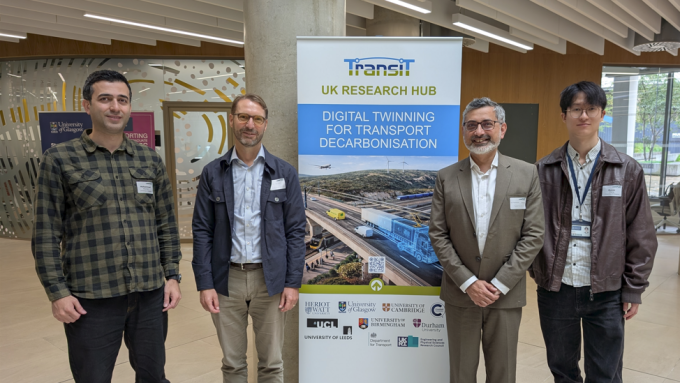
Transport decarbonisation specialists at UK research hub TransiT will share their learnings with industry guests through a series of workshops convened by Connected Places Catapult, the UK’s innovation accelerator for cities, transport and place leadership.
The event series will showcase TransiT’s work to identify low-risk, low-cost routes to zero emission transport in the UK using digital twins – digital replicas of the physical world – and reflects the UK government’s commitment to developing national capability in digital twinning to accelerate economic growth, net-zero goals and infrastructure resilience.
Digital twins are digital replicas of real systems – like transport networks, energy use, or travel behaviour – that allow ideas and improvements to be tested before acting in the real world.
Researchers from across the TransiT programme will co-host workshops with Connected Places Catapult at four events in June and September in London and Glasgow. Each event will focus on a different area of TransiT research: human factors, cybersecurity, cyber-physical systems and federation – where multiple digital twins are connected in a network.
David Flynn, joint programme director of TransiT, and Professor of Cyber Physical Systems at the University of Glasgow, said: “Digital twinning has the potential to derisk future decision making in industry, given its ability to suggest and test ‘what if’ scenarios. So it’s vital that we and other researchers in this field share our learnings to help the UK accelerate the transition from research to adoption. To that end, we’re delighted to be hosting this series of events with Connected Places Catapult.”
Justin Anderson, director of data and digital at Connected Places Catapult, said: “Decarbonising transport is critical – TransiT provides the evidence we need to shape effective national policy. Our focus is on working together to share knowledge and turn this important research into practical solutions that can be tested with system operators and adopted at scale.”
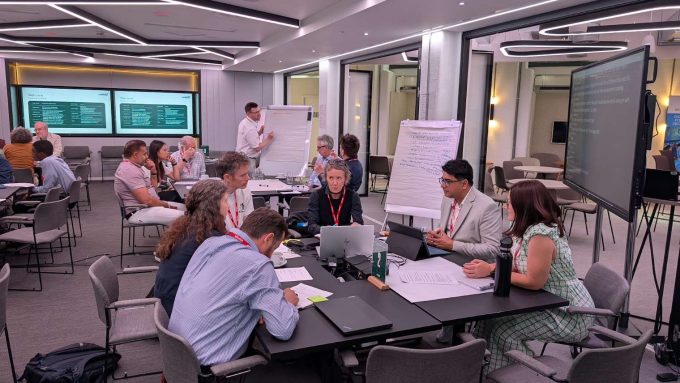
Designed as working sessions rather than conferences, the workshops will bring together an invited audience of industry practitioners, policymakers and researchers to explore challenges, test assumptions and surface practical insights that can inform both research and real-world deployment. Outputs from each workshop will be captured and shared to extend learning beyond the room and support wider uptake across the sector.
Each event addresses a critical barrier to the effective adoption of digital twins in transport; the schedule is now available.
9 June 2026, London, Cybersecurity in transport digital twins
(This event has finished)
The cybersecurity theme focuses on keeping transport systems safe and resilient as they become more connected. It will consider both the technical challenges of detecting, preventing and responding to cyber‑attacks across complex systems, and the organisational and governance issues that arise when multiple stakeholders are responsible for the design, operation and assurance of connected transport infrastructure.
23 June 2026, London, Humans and digital twins in transport decarbonisation
(This event has finished)
This theme focuses on why and how we capture human behaviour in transport digital twins, and also how people will use digital twins in transport. Whether it’s a control room operator managing rail services, a policymaker weighing up investment decisions, or communities planning journeys, digital twins only add value if people can understand and trust them. This theme explores what skills and readiness people and organisations need to use digital twins effectively. And we highlight why ‘human factors’ and human behaviour are critical enablers of adoption, safety and impact.
17 September 2026, Glasgow, The cyber-physical transport architecture of the UK
Registration open RESERVE A PLACE
Cyber-physical systems use sensors and telecoms networks to gather data from vehicles, roads and other physical transport infrastructure and feed this back to computers for operational and planning decision support. This event explores how digital twins designed to accelerate transport decarbonisation will integrate physical and digital transport assets across the UK. Topics will include interoperability, organisational readiness and strengthening collaboration between government, industry, telecoms providers, transport operators, academia and the energy sector.
1 October 2026, London, Designing for federation in digital twinning for transport
Registration open RESERVE A PLACE
A ‘whole system’ view of transport in the UK can help us better understand decarbonisation challenges. Federation can offer this, and involves linking together multiple digital twins across road, rail, air, and maritime into a single, interconnected network. This event explores the opportunities and challenges of creating this digital ‘system of systems,’ including practical considerations, industry standards – and how digital twin federation could deliver transport decarbonisation in the UK.
TransiT is a national UK research hub using digital twins and associated technologies to identify the fastest, lowest cost and least risky pathways to transport decarbonisation in the UK. It is a collaboration of eight universities and almost 70 industry partners, jointly led by Heriot-Watt University in Edinburgh and the University of Glasgow, and supported by the UKRI Engineering and Physical Sciences Research Council (EPSRC), the main funding body for engineering and physical sciences research in the UK, and by the UK government’s Department for Transport.
Leave a comment